

One small decision can derail your entire Roblox project before it even starts. Choosing the wrong category when posting a job is not a minor formatting issue. It determines who sees your listing, who applies, and whether you end up with a skilled Lua scripter or a generalist who has never opened Roblox Studio. Most clients skip past this step without a second thought, and it costs them days of screening, dozens of irrelevant proposals, and real money. This guide breaks down exactly why categories matter, how matching systems use them, and how to use them correctly every time you hire.
Table of Contents
- Why categories matter more than you think
- How categories shape talent discovery and matching
- Comparing category structures: Generic vs. niche-specific
- Applying category insights: How to post jobs for Roblox projects
- A hard truth: Why most Roblox clients get categories wrong
- Find the perfect Roblox freelancer with smart category use
- Frequently asked questions
Key Takeaways
| Point | Details |
|---|---|
| Categories filter for fit | Choosing specific categories narrows applicants to those with the right expertise, improving hiring results. |
| Niche improves outcomes | Niche-focused postings yield fewer but more relevant proposals and higher project win rates. |
| Hierarchies fuel AI matching | Structured category systems allow platforms to make smarter talent recommendations using AI. |
| Granularity prevents mismatches | More detailed category selection reduces the time spent reviewing irrelevant applicants. |
Why categories matter more than you think
Let's get one thing straight. Categories are not just labels. They are the primary filter that every job marketplace uses to route your listing to the right pool of talent. Get the category right, and your job post reaches scripters, builders, and UGC creators who actually know what they are doing. Get it wrong, and you are buried under proposals from people who have never touched a Roblox asset in their lives.
This is not a small difference. The impact on your hiring outcomes is significant. When you post in a broad, generic category, you signal to the platform's algorithm that your project is open to a wide audience. That sounds good, but it is not. You get volume without quality. Your inbox fills up fast, but the work of sorting through mismatched candidates falls entirely on you.
Here is what the data shows. Niche category positioning produces dramatically better outcomes: a generic "Web Developer" listing attracts 65 or more proposals with a win rate of only 3 to 5 percent, while a niche "Webflow Specialist" listing draws 12 to 18 proposals with a win rate of 15 to 22 percent. That is up to a 5x improvement in results simply by being more specific.
The same principle applies directly to Roblox hiring. Posting under a broad "Game Developer" category will pull in applicants from across the entire gaming industry. Posting under a specific "Roblox Scripter" or "Roblox UGC Creator" category filters the pool down to people with actual, relevant skills.
Beyond the numbers, there is a trust factor. Top freelancers pay attention to how a job is categorized. When a listing is placed in the right niche, it signals that the client knows what they want. That attracts serious professionals who take the project seriously. Vague categories attract people who are just casting their own wide net.
The category structures in freelance job boards are built to do heavy lifting for you. But only if you use them correctly. Here is a quick breakdown of what happens at each level:
- Broad category: Maximum visibility, minimum relevance, high screening burden
- Mid-level category: Balanced reach with moderate relevance filtering
- Niche or specialty category: Targeted visibility, high relevance, lower volume but far better fit
- Skill-specific tag: Precision targeting for exact capabilities like Lua scripting or Roblox map design
The bottom line is this. Categories are not administrative overhead. They are your first and most powerful hiring tool.
How categories shape talent discovery and matching
Understanding the power of categories, let's look at how the actual matching process depends on category structure.
Modern freelance platforms do not manually sort job listings. They use AI-driven matching engines that rely on structured data to connect the right talent with the right project. Categories are the backbone of that structure. Without accurate categorization, even the most powerful algorithm cannot do its job.
Hierarchical skill taxonomies power AI matching in marketplaces by organizing talent and jobs into layered structures: domain, specialty, and skill. Each layer narrows the focus and improves match quality. Here is how that hierarchy looks in the context of Roblox development:
| Level | Example |
|---|---|
| Domain | Game Development |
| Specialty | Roblox Development |
| Skill | Lua scripting, UGC modeling, map design |
When you post a job and select the correct category at each level, the platform's AI can instantly identify which freelancers in its database are the best match. It compares your job's category tags against freelancer profiles, portfolio keywords, past project history, and skill verifications. The more granular your category selection, the tighter the match.
"The more precisely a job is categorized, the more accurately the platform can surface relevant talent. Broad categories create noise. Specific categories create signal."
This matters a lot for Roblox projects specifically. Roblox development is a niche within a niche. A scripter who works in Unity is not the same as one who writes Lua for Roblox. A 3D modeler who works in Blender for film is not the same as a Roblox UGC creator who understands avatar asset constraints. The platform needs the right category data to make that distinction automatically.
When you browse Roblox design and scripting gig categories, you can see how specialty-level categories surface talent that a generic search would never find. That is the matching system working as intended.

Pro Tip: Always select the most granular, accurate category available. If the platform offers a "Roblox Scripting" subcategory under "Game Development," use it. Do not default to the parent category just because it is faster to select. That one extra click can cut your screening time in half.
The matching process also works in reverse. Freelancers who specialize in Roblox actively filter for jobs posted in the right categories. If your listing does not appear in the correct specialty category, you may never reach the best candidates, even if they are actively looking for exactly what you need.
Comparing category structures: Generic vs. niche-specific
To make this actionable, let's see how different category approaches work in real hiring scenarios.
Not all category systems are built the same. Some platforms use flat, two-level structures. Others use deep, multi-tier taxonomies that can go three or four levels deep. Understanding the difference helps you make smarter decisions when posting jobs on any platform.
Upwork's multi-tier structure is a good example of how this works in practice. A job in "Accounting and Consulting" can drill down to "Recruiting and HR" and then to "Talent Sourcing." Each level narrows the audience and improves search ranking for the listing. The same logic applies to game development categories, where drilling down from "Game Development" to "Roblox" to "Lua Scripting" produces far more targeted results.
Here is a direct comparison of what happens when you choose generic versus niche categories:
| Factor | Generic category | Niche category |
|---|---|---|
| Number of proposals | 65 or more | 12 to 18 |
| Proposal win rate | 3 to 5 percent | 15 to 22 percent |
| Candidate relevance | Low | High |
| Screening time required | Very high | Low |
| Quality of shortlist | Mixed | Strong |
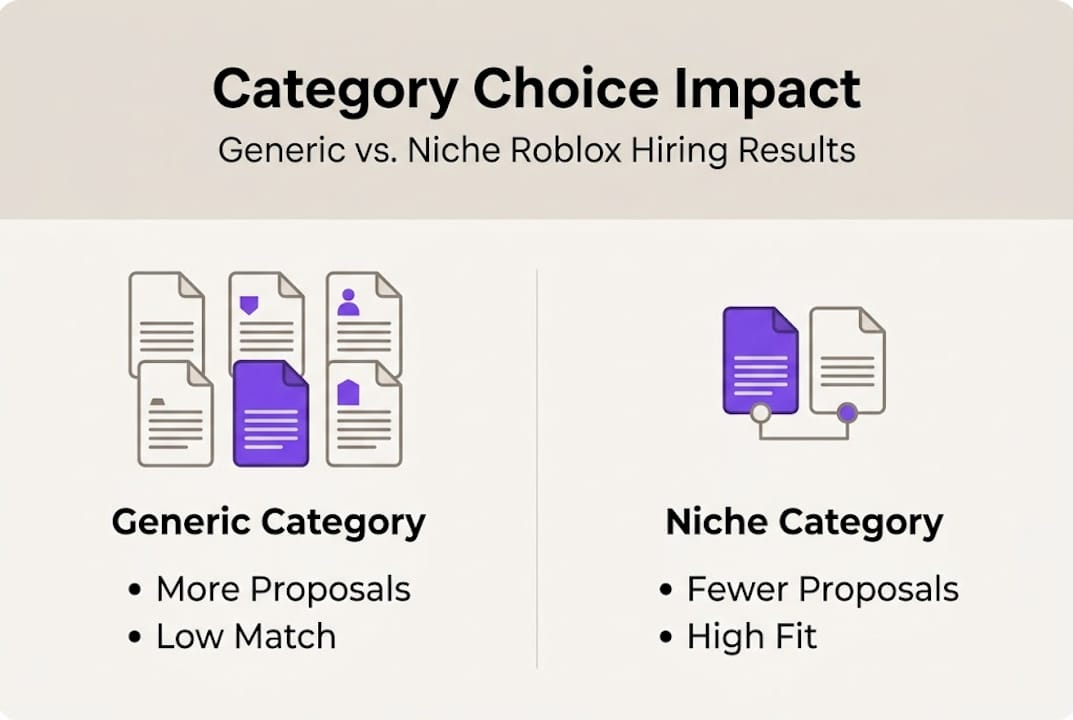
The data is clear: niche categories reduce proposals by 70 to 80 percent and boost win rates by 3 to 5 times. That is not a marginal improvement. It fundamentally changes how efficient your hiring process is. And there is a risk on the other side too. Using the wrong subcategory on some platforms can damage your project's success score through cancellations caused by poor-fit hires.
Here is a step-by-step look at how category choices play out differently in real Roblox hiring scenarios:
-
Generic posting ("Game Developer"): You receive 70 proposals. Forty are from developers with no Roblox experience. Twenty have some game dev background but no Roblox-specific skills. Ten are actually qualified. You spend three days screening to find those ten.
-
Mid-level posting ("Roblox Developer"): You receive 25 proposals. Most have some Roblox experience. About 15 are genuinely qualified. You spend one day screening.
-
Niche posting ("Roblox Lua Scripter"): You receive 12 proposals. Ten are directly qualified with portfolios showing Roblox-specific work. You spend a few hours reviewing and can move to interviews the same day.
The third scenario is not just faster. It is better for your project. You are talking to people who understand Roblox Studio, know how to write clean Lua, and have shipped real games. That expertise shows up in the final product.
Applying category insights: How to post jobs for Roblox projects
Having compared structures, here's how you can leverage categories to maximize your hiring success for Roblox projects.
Knowing why categories matter is only half the equation. The other half is applying that knowledge every time you post a job. Here is a practical framework for doing it right.
Start with your project's core deliverable. Before you open a job posting form, write down exactly what you need. Is it a scripted game mechanic? A custom map? A UGC avatar item? A full game build? The deliverable tells you which category to use. A scripted mechanic points to "Roblox Scripting." A custom map points to "Roblox Map Design" or "Roblox Building." A UGC item points to "UGC Creation."
Use every available subcategory level. Most platforms let you select a primary category and one or more subcategories or skill tags. Use all of them. The more data you give the platform, the better the match quality.
Write your job title to match the category. If you post in "Roblox Scripting," your title should include words like "Roblox scripter," "Lua developer," or "Roblox game mechanic." This reinforces the category signal and helps both the algorithm and the freelancer understand the scope immediately.
When finding the right Roblox freelancers, avoid these common mistakes:
- Posting in "Game Development" without a subcategory: This is the most common error. It is too broad and attracts off-platform talent.
- Using a category based on tools instead of output: Posting under "Lua Programming" instead of "Roblox Scripting" may attract coders who have never worked in Roblox Studio.
- Skipping skill tags: Tags like "Roblox Studio," "UGC," "obby design," or "combat systems" add precision that subcategories alone cannot provide.
- Ignoring platform-specific categories: Some Roblox-focused platforms have purpose-built categories. Use them instead of defaulting to generic game dev options.
Pro Tip: After posting, check the portfolios of the first five applicants. If their work does not match your project's needs, your category selection may be off. Adjust the category or add more specific skill tags before more proposals come in. Catching this early saves significant screening time.
The goal is to make your listing as easy as possible for the right person to find and as easy as possible for the wrong person to ignore. Precise categories do both at once.
A hard truth: Why most Roblox clients get categories wrong
Here is something we see consistently. Clients assume that posting in a broad category gives them more options. More proposals, more choices, better odds. That logic sounds reasonable. It is wrong.
Casting a wide net does not give you better results. It gives you more work. You end up spending hours filtering out unqualified applicants instead of spending minutes reviewing strong candidates. The best Roblox scripters and builders are not browsing generic "Game Developer" listings. They are looking in the categories that match their specialty. If your listing is not there, they never see it.
There is also a trust dynamic at play. Experienced freelancers evaluate clients just as much as clients evaluate them. A job posted in the wrong category signals that the client does not fully understand the work. That can push top talent toward other listings where the client clearly knows what they want.
From what we observe across the Roblox development community, narrowly defined job postings consistently attract stronger candidates, generate faster responses, and lead to better project outcomes. Precision is not just a technical optimization. It is a signal of professionalism that the best creators respond to. If you want to work with the best, post like you know what you are looking for.
Find the perfect Roblox freelancer with smart category use
If you're ready to apply these insights, here's how RoTalent can help streamline your hiring journey.
RoTalent is built specifically for the Roblox community, which means the category structure is already optimized for the work you need done. You do not have to navigate a generic freelance platform and hope the right talent shows up.
Browse dedicated categories for scripting, building, UGC creation, map design, and more on the Roblox freelance job board. Every category connects you directly to verified creators with Roblox-specific portfolios and reviews. Post your job with precision, reach the right talent fast, and move your project forward without the noise of irrelevant proposals. RoTalent makes category selection simple so you spend less time screening and more time building.
Frequently asked questions
Why is choosing the right category so important for hiring Roblox freelancers?
The right category filters applicants so you reach specialists who match your project, raising success rates and saving time. Niche category use can improve proposal win rates from 3 to 5 percent up to 15 to 22 percent.
How do AI-powered platforms use categories to match talent and projects?
Marketplaces use hierarchical skill taxonomies structured as domain, specialty, and skill to connect job listings with the best-suited freelancers through AI-driven matching engines.
What's the biggest mistake clients make when posting Roblox jobs?
Choosing generic categories attracts too many mismatched applicants and lowers the chance of finding a true specialist. Niche positioning reduces irrelevant proposals by 70 to 80 percent.
Can using the wrong subcategory harm hiring outcomes?
Yes. On some platforms, wrong subcategory selection leads to poor-fit hires, cancellations, and reduced project success scores that affect your standing as a client.
How granular should I go when categorizing my Roblox project?
Be as specific as possible. Use skill-level taxonomy by selecting domain, specialty, and individual skill tags to get the most accurate freelancer matches for your project.